
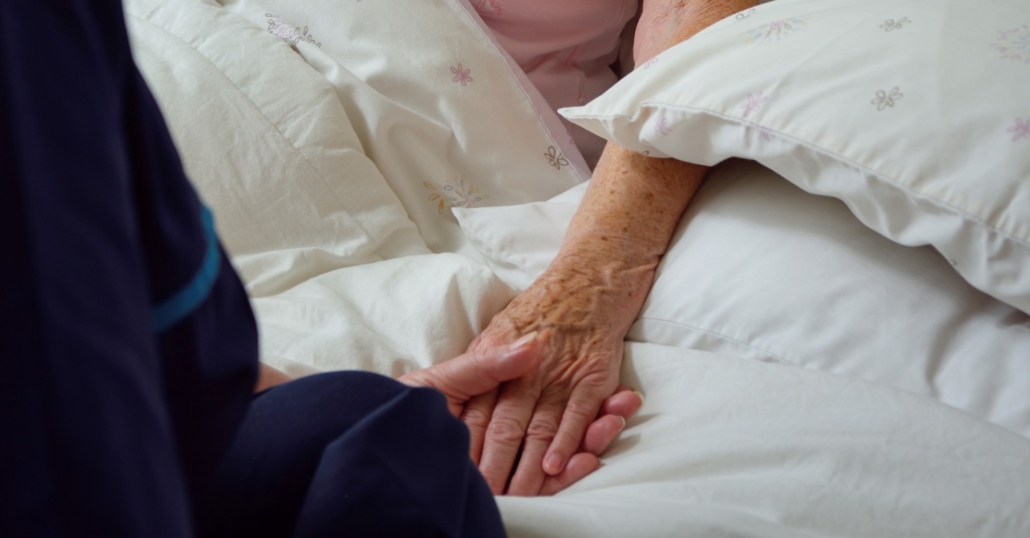
‘We needed to keep Mum at home because that’s where she wanted to be. I would not have coped with the support of the Hospice at Home team – I would’ve gone under.’
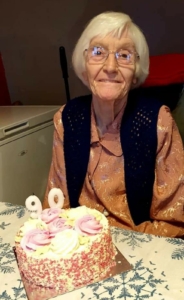
Jean
Beverley’s mum, Jean was cared for at her home in Hayfield by our Hospice at Home team before she sadly died in December 2021. Beverley, and her daughter, Jodie, who both live in nearby New Mills, explain more about the care that Jean received…
Beverley said: ‘We have always been a really close-knit family – we don’t live in each other’s pockets but we all know that each other is there. It was back in November 2019 that Mum had a funny episode and she called to ask me to go round. I rang Jodie and asked her to come with me – she had previously done care work in the community care team. We both knew when we first saw Mum that something wasn’t quite right. We thought initially that she’d had a stroke.’
Jodie added: ‘Out of the blue, Nana told us that there had been blood in her poo when she was going to the toilet. We knew she’d kept this to herself for a long time. Doctors visited Nana at home on four different occasions and stated they couldn’t find anything to worry about, further stating it was probably because of bowel polyps* that Nanna had previously had surgery on. We were informed that they would not operate on her again though, due to her old age.
‘Dr Keogh from Sett Valley Medical Centre rang my Mum, Beverley, and said he had looked at Nana’s blood test results and her haemoglobin levels were very low and arranged for a scan. Later, in March 2020, Nanna was sent for a scan – where we found out the tragic news that she had bowel cancer. Devastatingly, the cancer had spread close to her bladder; it was far too advanced to operate on. Nana confided in us that she suspected she’d had cancer for a long time.
‘Mum and I made the decision to care for Nana ourselves, she remained fiercely independent and was very demanding – she nicknamed us Laurel and Hardy; through the sad times we drew strength from Nanas sense of humour. It was heart breaking because Nana never wanted you to leave and would cry when it was time for us to go – she was scared of being on her own.
‘Having a background in care work, I thought caring for my Nana would be easy due to previous experience in the care field, however caring for a loved one is much more personal and it was extremely hard to separate emotions from the tasks in hand on occasion.’
Beverley continued: ‘Mum was incredibly stoic and wanted to maintain her independence – she was a proud woman and it was hard to explain to her that we needed extra support. She kept having falls but she maintained that she didn’t need anyone else except her daughter and granddaughter to take care of her; and she was adamant that she wasn’t having anyone else in her home. Tina Wild, advanced nurse practitioner at Sett Valley Medical Centre in New Mills, spoke to us about getting extra support from Blythe House. After some conversations between family, Mum accepted that we would all benefit from a little outside help and support. When you are caring for a loved one who is so poorly it is a constant cycle of emotions- highs, lows, good times, sad times – you lose contact with the outside world because you dedicate your life to ensuring your loved one has the best care and they are never alone.
‘As Mum became weaker and more poorly, it was taking her almost two hours to get to the bathroom to have a wash, and because she became so tired, she was at high risk of falling. She continued to be so independent and wanted to do this all herself. However, after one particularly bad fall, we had to call an ambulance. After this, Mum accepted that she needed to accept extra help. Tina Wild referred Mum to Blythe House in April 2021.
‘Mum was very well aware of the hospice as she came for counselling sessions after my Dad, Fred died, and was also a member of one of the support groups. She used to look forward to her visits to the hospice – it got her out of the house and socialising with others in similar situations.
‘At first, Mum was still very unsure about having healthcare assistants (HCAs) in her home. But we need not have worried. On the first visit, as luck would have it, the healthcare assistant, Kevin, was someone that the family knows. Kevin used to work with my Dad so he spent the time reminiscing with Mum and telling her stories about Dad – this really put her at ease. The HCAs prepared food and made drinks for Mum, and offered her companionship.
‘As Mum’s illness progressed and the visits became longer and through the night, she built up a real rapport with every healthcare assistant who came to visit her – she was really afraid of being on her own. She would ask me: “Who’s coming tonight?” She loved seeing photographs of their families, grandchildren and pets. We think Mum protected us a lot; she never complained of any pain but she opened up to the HCAs about her diagnosis. Some of the HCAs would sing with her, but if she wanted to rest, they’d monitor her throughout the night.’
Jodie said: ‘Towards the end, Nana’s health was really up and down – doctors told us to gather the family on four different occasions because they thought she was imminently dying. Nana’s mental health really suffered, and she’d ask us questions like: “When am I going to get better?” She started sleeping a lot more, and was asleep more than she was awake.’
Beverley continued: ‘A decision was made to set up a syringe driver (A piece of equipment that delivers medicines throughout the day and night) for Mum, to help manage her agitation. On the 16th December, Mum said to me: “I’m going to die tomorrow.” It was surreal, because the next day, Mum went downhill. Philippa, the Hospice at Home HCA, held Mum’s hand as she explained to us what would happen and what to look out for.’
Jodie said: ‘We played my Grandpa’s favourite song “Unchained Melody” by Robson and Jerome, and even though she was effectively asleep, she was smiling as it played. It was so strange, because we had been here before so many times; we honestly expected her to sit up and ask for a cup of tea or a sandwich, but her breathing became more ragged. We stroked her hair, told her she was safe and to go and find Grandpa. She died on 17th December, aged 91.’
Beverley said: ‘When Mum was first diagnosed with cancer, I was quite cocky. I said: “I’ll look after her no problem!” We needed to keep Mum at home, because that’s where she wanted to be. Supporting palliative care for a loved one is emotionally exhausting, something I greatly underestimated. With the help of the Hospice at Home team we were able to fulfil mum’s wishes and keep her at home in her familiar surroundings. Without the support of the Hospice at Home team, Mum would’ve had to go into hospital, something she desperately didn’t want.
‘The Hospice at Home team was constantly there for us, either in person or at the end of the phone day or night – they didn’t sugar coat anything, they told us exactly how it was, and we really liked that, so we were prepared and aware as a family. The HCAs became my support network and my friends; they were there for me as much as they were there for Mum. She was seeing different people, having different conversations; they relieved my guilt of having to have carers to support us, and I knew she was so very well cared for.’
- Find out more about the Hospice at Home service.
- Could you help us to launch a brand new Rapid Response Hospice at Home Service? Find out more and donate to our appeal.


