A space to reflect, talk and feel supported
Spiritual Care at Blythe House Hospice – A blog to mark International Spiritual Care Week

Spiritual Care at Blythe House Hospice – A blog to mark International Spiritual Care Week
Spiritual care is about much more than religion. It offers time and space to explore the things that matter most to us, find comfort during difficult times and talk about our hopes, fears and questions about life.
At Blythe House Hospice, our volunteer Spiritual Care team offers a listening ear and compassionate support to patients, families and those close to them. Everyone’s experiences and beliefs are different, and spiritual and pastoral care is there to meet people wherever they are, without judgement.
To mark Spiritual Care Week (18th to 24th October 2026), our Spiritual Care team has shared some of their thoughts on what spiritual and pastoral care means and the difference it can make.
Introduction by Tom Parker
Spiritual Care Week or Pastoral Care Week has been set aside internationally since 1985 to help us to celebrate and give thanks for those who care for us spiritually and pastorally.
So here at Blythe House we give thanks for and celebrate everyone who does this in any way – for neighbours and friends, for those caring for loved ones at home, for our hospice staff and our Spiritual Care Team. We are grateful for those who make time to listen, to be alongside and to stand with us when we are hurting.
The theme of spiritual care week this year is ‘Healing through presence and grace’ and draws on the Japanese practice of ‘Kintsugi’ where broken pottery is repaired with gold, silver, or platinum lacquer. Rather than hiding the cracks, Kintsugi highlights them—transforming what was once broken into something more beautiful and valuable.
We are all to some extent broken, so we give thanks for those who help us to be repaired by their presence and compassion.
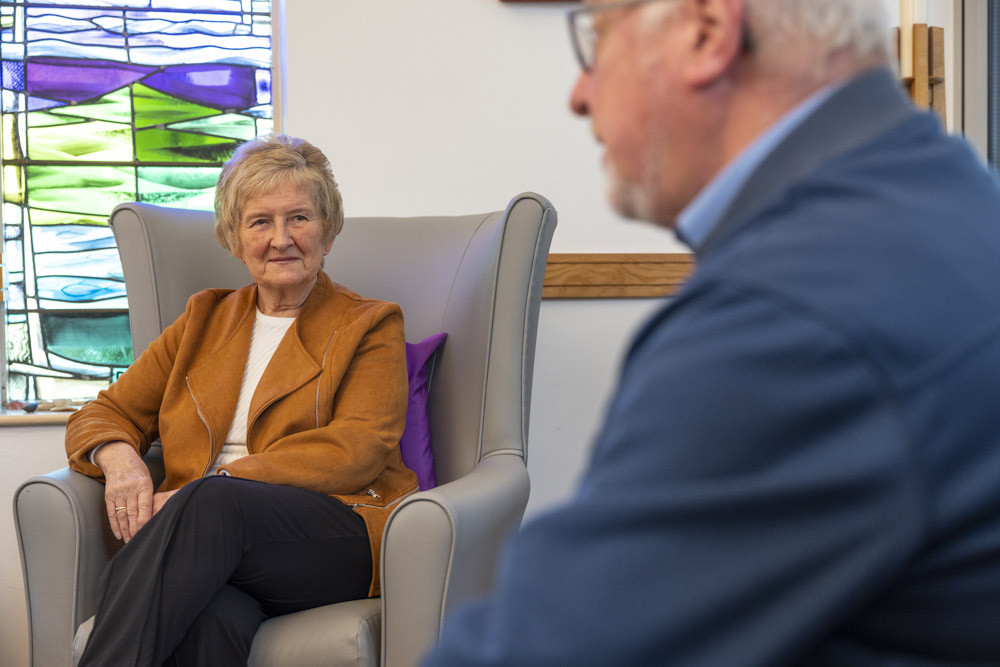
Anne
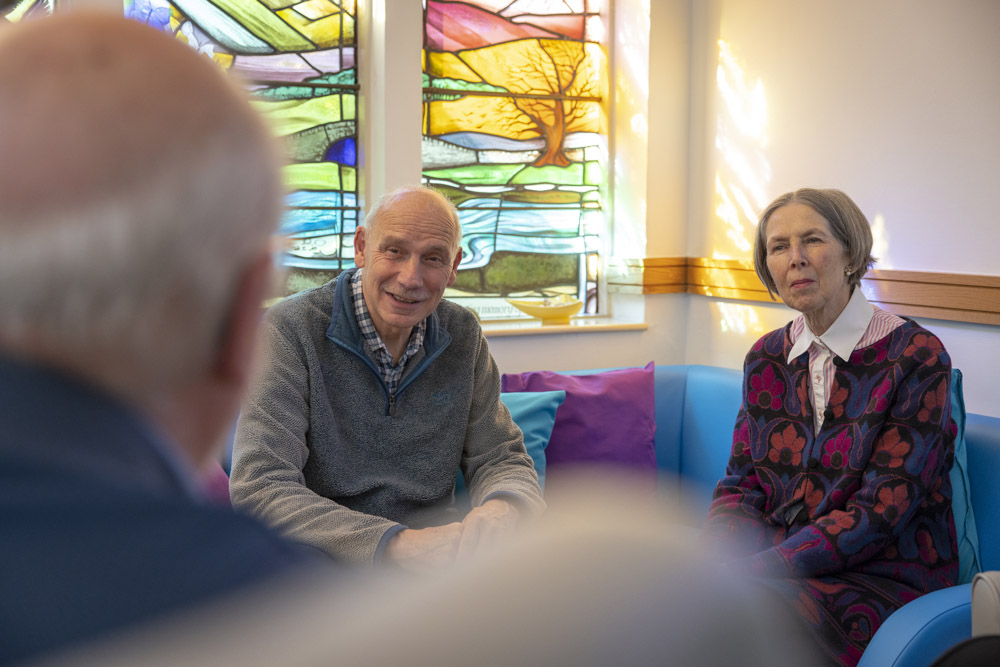
Tom and Christina
Spiritual Care at Blythe House Hospice by Anne Cawthorn
The Spiritual Care team provide support in a variety of settings; in Blythe House, in people’s homes and at events, such as Sunflower Memories and Light up a Life.
The team have a presence at the monthly coffee mornings, chatting to those who just come to enjoy this social event. However, they are also available for anyone who wants to share the on-going difficulties in their lives. Sometimes it is to offer a listening ear in a compassionate conversation with those who are distressed, perhaps due to a new diagnosis, or re-occurrence of their disease. Staff are available to take a referral into the service if requested.
For those who are bereaved, we provide a non-judgemental space, where they can share the rollercoaster of feelings experienced at this time, and the confusion that this brings.
For others, it is an opportunity to visit the place where they have received support, or where their loved one was supported. Those who have been in this position will agree that this isn’t an easy thing to do but knowing that there is support if they need it, can be helpful. If you’re not sure if this is for you, please ask and we can take it from there.
Compassion by Keith Munnings
Practicing compassion begins with kindness, to oneself and to others.
It may be most helpful, but not easy, to sit with our suffering and the impact it is having.
Compassion can grow deeper when we give ourselves the space and time to allow human kindness to touch our brokenness and make us whole again.
Suffering and brokenness by Christina Johnson
It is impossible to get through life without suffering. Sometimes we are encouraged to believe that certain highly gifted people – like celebrities – do, but later we come to realise that in hidden ways they had their own difficulties.
If health is about body, mind and spirit, it is unlikely that doctors, nurses, or members of a Spiritual Care team, alone, can help the whole person. It requires a wider cooperation.
When anyone has serious health problems, they are likely to feel upset. And once we are upset, we can become anxious, afraid, and emotionally negative. This is the natural fretting of our spirit as it endeavours to come to terms with the changed situation, and it is unhelpful to ignore these feelings.
Having a calming witness might enable us to release, explore and hopefully diffuse our emotions. With someone alongside to help us seek meaning and purpose, a person with the time to hear and pay attention to our story, and to express empathy for our individual experience, we may be supported to see a way through.
Hospitals can be busy and challenging places, and the primary concern of the sometimes-stretched medical staff, is to perform their task of attending to bodily issues. For the Spiritual Care team, the focus is entirely on your spirit: how you are feeling. They will be interested in what sustains and keeps you going, the worries you might have, the people that you care about, and any practical needs they can help you with in relation to your beliefs or spirituality, whatever it is.
We all have sources of security and comfort. For some people these come from organised religion, for others the need to find meaning and purpose when they are in difficulty. Should patients have specific religious care needs in relation to God and faith practices, representatives of that faith would be sought to assist them.
The Japanese have a practice called Kintsugi. It is the process of repairing broken pottery with gold, or similarly precious metals. This honours brokenness, rather than hiding it. The wisdom of this practice is that it recognises that our scars can eventually lead to deeper resilience – and even a new form of beauty. Thus, by refusing to deny or avoid our suffering, we are more likely to move towards acceptance, and eventually a deeper personal integration.
The power of music by Charlie Barnes
As well as being a member of the Spiritual Care team, I am a classically trained musician. I have thus always been interested in the role music plays in our work, and have had plenty of opportunities at Blythe House Hospice, and around hospital wards, to see its benefits first hand.
In the hospice, I run a small group called Talking About Music, where people can listen to a couple of pieces and ask questions about them. This is not everyone’s cup of tea, but some people truly appreciate the chance to really listen, rather than treating music as background. I also play sometimes for the mindfulness session at the end of the Thursday Peer Support group meeting, where carefully chosen pieces enrich the atmosphere in a way that background music never could.
Music, if it is played live and well chosen, goes straight to the heart, and, in the Spiritual Care context, forms a real bridge between me and the listener. I know from my experience working with dementia choirs how powerful this can be. I believe passionately in its power and use it whenever I can.

Charlie


