

It was a poignant day for Clare when she visited Blythe House on 9th November to share her story about the hospice care that her husband, Simon, received at the end of his life. Clare should’ve been celebrating Simon’s 57th birthday that day, but sadly Simon died in May 2022, just eleven months after his diagnosis with Stage IV metastatic lung cancer.
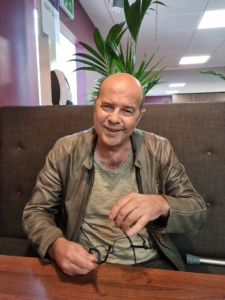 Clare, who lives in New Mills, explained: ‘The lead up to Simon’s diagnosis was confusing. He had no visible symptoms at all; no cough or anything to alert us that there was something wrong. We moved to the High Peak in April 2021. Towards the end of May, Si called me from the hallway: “Clare, help me, I can’t walk. I am having to think about how to walk.” Si was a very active man; he loved walking and nature, especially bird watching, and he worked as an IT project manager at the University of Manchester, following many years as a self-employed IT consultant.
‘Si kept having very intense headaches, and he would quite literally have to crawl up our stairs. I said to him: “You need to go and get checked out!” Si drove to Stepping Hill Hospital and within a few hours, a consultant there called me and said I needed to go to be with Si. After many scans and tests, Si was told he had six cancerous tumours in his brain, that had spread from his lungs. They also found it had spread to his liver and adrenal glands [located on top of both kidneys]. His prognosis was six months – potentially a few more.
‘Si was very accepting of the devastating news but I was absolutely heartbroken and I totally crumbled. It was such a shock. His brain tumours meant he could no longer drive. Si started to attend The Christie and Salford Royal hospitals to undergo treatment. We took it day by day. He underwent stereotactic radiosurgery, where he had to wear a special mask to keep his head still as precisely focused radiation zapped the cancer. The treatment was to slow down the spread of the cancer; at this point there was nothing they could do to actually get rid of it.
‘Si was still reasonably mobile; he had a stick to get about and he explained that he felt like he was constantly on a ship, feeling very dizzy. Si also started having seizures; it was absolutely terrifying. He would fit so badly; I’d have to get him onto the floor and hold his head to protect his airway. Si went back to hospital where they prescribed anti-seizure medication. I had pulled out onto the A6 in rush hour as we were driving home, we’d literally got to the Sainsbury’s in Hazel Grove, when Si had a seizure in the car and I have never been more scared in my life.
‘The brain tumours affected Si’s speech and memory. He was a very articulate man and found it really difficult to speak and form sentences at times. But, he stayed very positive. He would speak to his brothers and only give the positives, not the reality. Then his brothers would ring me and say: “What’s really happening?” Si underwent some chemotherapy at The Christie, but specialists would only allow four sessions at 65% intensity, because they were incredibly concerned about balancing Si’s quality of life, and his body was just too weak.
‘Dr Sarah Parnacott [consultant in palliative medicine at Ashgate Hospice and trustee at Blythe House and Helen’s Trust], became involved in Si’s care, alongside Liz and Lesley from Ashgate who were a specialist nurse and support worker respectively. They came and visited us at home, and they were just incredible. Dr Parnacott gave me her mobile number; she said: “Ring me for anything.” I felt so safe. The whole experience was really isolating for me. I was responsible for, and did everything for Si. I was advocating for him, sorting his medications, giving injections and doing observations at home; caring became my full-time job.
‘Miriam and Angela, occupational therapist and physiotherapist at Blythe House Hospicecare, came to visit us and they were just amazing; much to Simon’s horror that he now needed all these aids to get around the house. It was hard to admit for him that he was not as strong as he used to be. Miriam and Angela liaised with partner organisations to help us around the home, including getting a bannister fitted as our rented home didn’t have one; rises over the loo for Si to be able to get on and off the toilet; stools for the shower; rails around the house and outside on our drive. Later, they worked with the Fraser-Thomson Foundation in Disley to get a curved stairlift fitted.
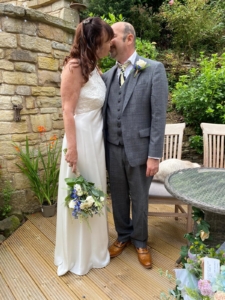 ‘Dr Parnacott was kind enough to help us get married at home in September 2021. After being together since 2017, we were due to have a big wedding day but Covid-19, and then Si’s prognosis, confirmed that this could not go ahead as planned. We were joined by my children and a registrar in our garden. It was a beautiful day, and we were due to have a small gathering of family and friends the next day to celebrate but unfortunately Si was just too weak and poorly.
‘Blythe House’s community volunteer programme also supported us. Tom, a community volunteer, came around to sit with Si to give me the opportunity to go out, run errands, go to the doctors, to get my hair cut, pick up medication or do some shopping. Tom and Si got on so well. Tom worked with Si to help re-build a bird table in our garden, and Si just absolutely loved his time with Tom.
‘Si and I also accessed support and services at the hospice building in Chapel-en-le-Frith. Si would enjoy having massages to help ease the pain of lymphoedema swelling in his legs. Not long after, the Hospice at Home service also got involved to provide care and support to Si at home. The healthcare assistants were angels, they really were. They were such a help. Even the smallest things like making a cup of tea, having a chat or doing the washing up. One day, when Si was resting, I walked into the kitchen and a healthcare assistant was stood at the sink. I said: “What are you doing? You can’t do that!” And she simply answered: “I can do what I want to help you!” I can’t explain the sense of relief; the feeling of having some normality during those times when someone was watching Si and I could have just a few hours to myself.
‘Si wanted to stay at home; he was so determined to die in his own bed, with his beloved family and cats beside him. In the last 24 hours of his life, Si became more and more tired, and slept more. At around 1am in the morning, I nodded off next to him on the bed, fully clothed, and when I woke up, he had passed away. I couldn’t believe it; I didn’t know what to do. A district nurse and a Hospice at Home healthcare assistant came around to certify Si’s death. I felt like I had lost my job; I had been so busy for 11 months; I just didn’t know what to do with myself.
‘We had previously talked about Si’s funeral and his wishes; he very much wanted to be involved in the planning process, choosing his music and even the cemetery where he’d like to be buried. Si also told me his wishes for his clothes and belongings; giving items to his family and donating stuff to Blythe House’s charity shop. It was great for me, as he’d decided everything and it meant I didn’t have any difficult decisions to make. Going through this process with Si made me realise how important it is; and I need to do the same with my children to give them some support and relief so they don’t have to think about that when anything happens to me.
‘Si had an ongoing joke with our beloved cat, Rufus, who he had rescued many years ago. Rufus was 21-years-old and Si would joke and say: “Who’s going to go first? Me or the cat?” Turns out that Rufus beat Si to it; Rufus died in February, with Si passing away on 17th May. Rufus’ ashes are with Si in his coffin; they have been reunited.
‘After Si’s death, I continue to receive support from Blythe House. I visited the hospice to meet the Community Hub team; I needed to be here and I just feel so safe. I also have had counselling which is my safe space to just talk. I have attended the bereavement support group, ran by the hospice in partnership with High Peak CVS. I needed to ask the question: “Is this feeling normal?” I had been by Si’s side 24/7 for the last year, including before that, throughout the Covid-19 lockdowns. I missed him and his presence terribly.
‘The whole process of Si’s illness was a real eye opener. I had heard the word “carer” before, especially in my job working in corporate services for the NHS for the past 20 years. But. I never realised the magnitude of the role. I have a huge and incredible respect for anyone who is a carer for a loved one. I can’t believe I did it; I’m very proud of myself. But that’s what you do when you love someone.’
Learn more about how our range of hospice services could support your loved one.


