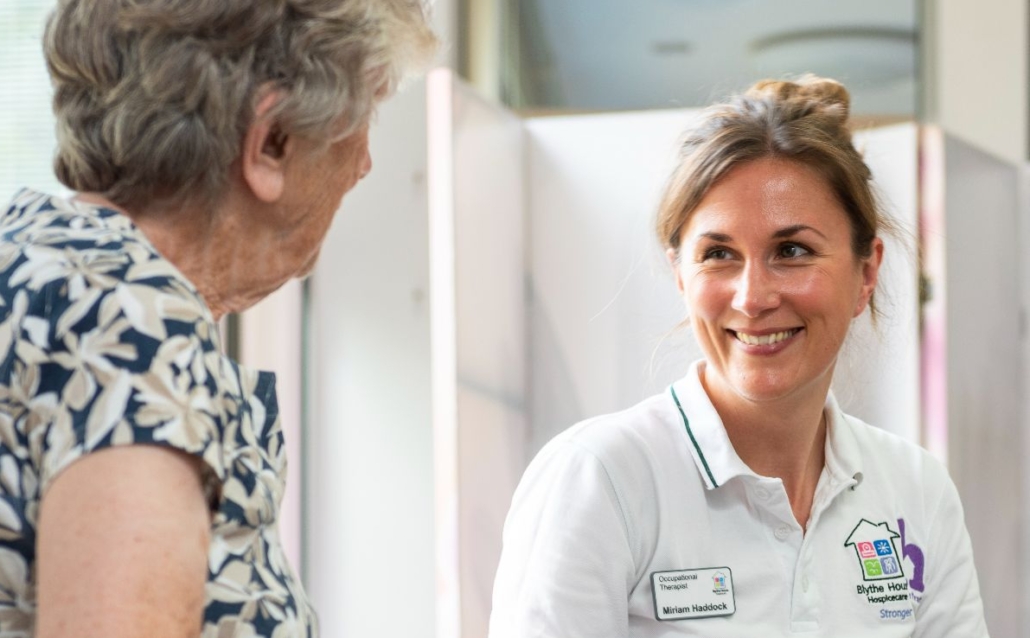
Miriam Haddock is the occupational therapist (OT) here at Blythe House and Helen’s Trust. She has worked as an OT for over 15 years; moving around a lot from the Midlands to the Highlands, due to her husband’s job in the Royal Air Force. These changes have allowed Miriam to gain knowledge of good practice around the UK, and then apply it to her own clinical work.
In the past, Miriam has worked for a number of hospital trusts, and being a part of community teams, both as an active team member and a team lead, is a great passion of hers. Miriam has been able to gain varied experience in neurology, surgery, oncology and general rehabilitation.
For Miriam, a favourite aspect of here role at the hospice is: ‘Having the privilege to be welcomed into someone’s home at a time when they are perhaps at their most vulnerable, both physically and psychologically. I often get to know not only the patient but have the pleasure of meeting their family too, where on many occasions multiple referrals will be made to the hospice team, enabling us to support everyone involved.’
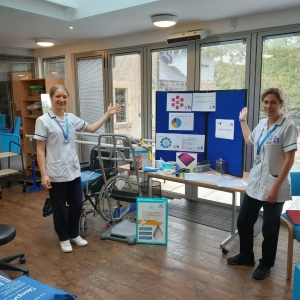
Miriam said: ‘Whilst working alongside colleagues internally at Blythe House and Helen’s Trust, I also get to work with lots of other community teams including: the neuro team, district nurses, community matrons, rapid response, community rehab team, GPs, continuing health care, to name a few. I love working with such a variety of people, all focused on the same aim, to provide the best possible care for the patient and their family.’
An OT provides practical support to empower people to overcome barriers that are preventing them from doing activities (occupations) that matter to them. Providing this support at Blythe House and Helen’s Trust increases people’s independence and satisfaction in all aspects of life.
In her day-to-day role as an OT, Miriam helps to support and educate patients with:
- Activity analysis, advice and retraining on continuing activities and interests that are a priority for a patient (such as getting in and out of bed; washing and dressing; using the bath, shower and toilet; managing the stairs; preparing drinks, snacks and meals; playing with children on the floor, and participation in sports)
- Working and driving advice
- Assessment and provision of specialist equipment to enable people to remain as safe as possible and independent
- Assessment of muscle tone with regard to splinting for hygiene and comfort.
- Upper limb and hand rehabilitation for chemotherapy induced peripheral neuropathy (nerve damage caused by chemotherapy)
- Lifestyle management advice to cope with fatigue or altered level of independence
- Assessment of moving and handling, and advice regarding all transfer methods throughout stages of illness
- Falls assessment
- Sleep management
- Stress and anxiety management advice, and relaxation techniques
- Cognitive assessment
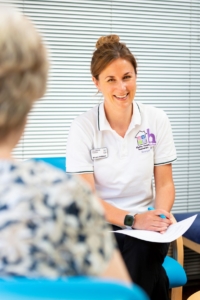 For the patients we provide care for at Blythe House and Helen’s Trust, Miriam’s role is vital in being able to give people the opportunity to build physical, social, environmental and psychological support; improving their meaning of life. This is through either 1:1 sessions at the Blythe House Community Hub, in a patient’s home – if that’s appropriate to them – or in a group setting.
Miriam, along with our expert nurses, and physiotherapist, host an eight-week fatigue, anxiety and breathlessness (F.A.B) programme, which aims to give our patients self-help strategies to support these symptoms, overall improving how they feel. These sessions run from 1:30pm-3:30pm on Tuesdays. Find out more.


