Blythe House and Helen’s Trust cared for Helen’s beloved dad, John, in the comfort of his home alongside DHU Healthcare’s palliative care urgent response service, before he sadly died in January 2023. His family did everything in their power to keep John at home, as ‘under no circumstances’ did he want to die in hospital.
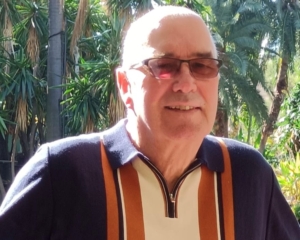 John, from Pilsley, was diagnosed with oesophageal cancer in June 2022, after a long period with a niggling, ongoing cough and phases of feeling very unwell.
New roaming car service
Since the Covid-19 pandemic, the need for Blythe House and Helen’s Trust’s Hospice at Home care has never been more apparent. GP surgeries and hospital services are busier than ever, and many more people, like John, wish to be cared for in the sanctuary of their home.
This increased demand means we have to build upon the service to ensure that we can respond quickly to all those who need our support. Later this year, we’re set to launch a brand-new roaming car service to complement our hugely successful Hospice at Home team and work closely with DHU Healthcare’s palliative care urgent response service, to provide even more care to local people who need it.
The new roaming service will see expert nurses with palliative care experience, and compassionate healthcare assistants, support patients across North Derbyshire from 10pm to 7am, to administer medication, manage symptoms and provide nursing care; keeping patients at home, and out of hospital.
This means that if a local patient experiences a decline in their circumstances and needs nursing support anytime during the night, they will have access to the Hospice at Home team, even when they don’t have an overnight hospice care package planned.
John’s diagnosis
Helen explained: ‘As a large family, cancer is something we’re quite familiar with. We’ve experienced most cancers; and most of them have been terminal. I had my own taste of breast cancer in 2010.
Dad contracted Covid-19 and was quite unwell in late 2021, but during the winter of 2022 he developed a niggling, ongoing cough which doctors put down to being a post-Covid cough. He had chronic obstructive pulmonary disease, severe asthma, and was taking medication for his breathing; so the things that medics were saying were not unreasonable.
‘In February 2022, Dad confided that he thought he might have cancer. He said “although they’re telling me one thing, I think it’s more than that.” If there’s one thing after this experience that I’d say to anyone who has a hunch that something is not right, just keep going back. I think sometimes there is an element of not wishing to be disrespectful and that you don’t want to doubt a medical professional’s knowledge and experience, but just don’t be afraid to question their conclusions and have your say.
‘Later, in spring, Dad went to visit my sister, Sara at her home in Australia. He was thinking that the sunshine and warmer weather might help his condition improve, but sadly, unfortunately, it got worse. When he came home, he went back to the doctor and underwent tests and scans, where he was diagnosed with terminal oesophageal cancer. He didn’t have long left, but he didn’t want timelines and he didn’t want to know.
‘Dad made a quick decision early on that he wanted to tell the people he was closest to, and to spend his remaining time with people of value. Family was always important to him, and Dad said he wanted to leave us all with something to laugh and smile about. Dad started to set goals of things he wanted to see and do. He wanted to reach birthday milestones for Sara and I; to see my son, his grandson, finish his GCSEs and go to college, and to see my niece achieve educational milestones in Australia. Dad had been a member of the Royal Antediluvian Order of Buffaloes since 1974, so fundraising, charity and the social aspect of the group was also very important to him.
‘Dad had previously completed a ReSPECT form, so that healthcare professionals and family could see and respect his wishes. He’d said that under no circumstances did he want to die in hospital. As a family, we of course agreed, and we did everything in our power to keep him at home. When you’re trying to care for someone, it’s understandable that you might have your own questions. Dad gave permission for medical teams to answer our questions. He didn’t want to be in the room to hear the answers, but he desperately wanted us to meet his need to be at home, so he knew we needed to ask those important questions. I would say don’t ever be afraid to ask those questions; they are so vitally important when you’re looking after a loved one who is so poorly.
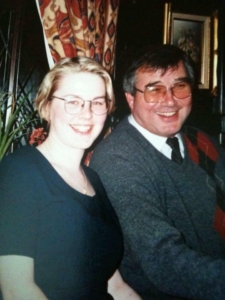
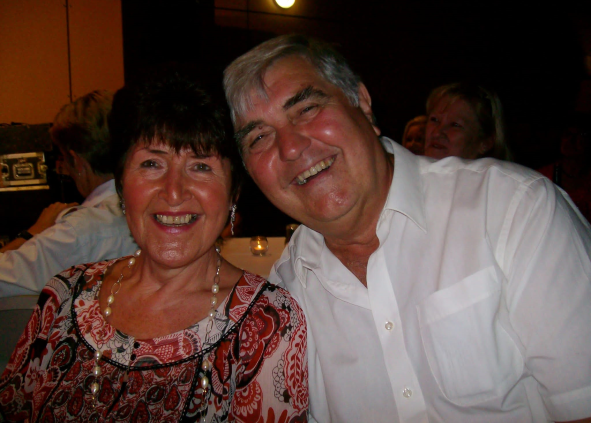
Helen and John on Helen’s wedding day
Having important conversations
‘In October, the writing was on the wall and we thought that Dad didn’t have very long left. The cancer had progressed incredibly quickly and at that point we thought it might be a matter of days. We used time to chat through all Dad’s wishes and thoughts. He answered all my questions and there are no conversations that we didn’t have. He told me the answers he’d give to me if I was to ring him for advice today. We also knew exactly what we were doing at his funeral; we had strict instructions, with hard and upsetting conversations, but they meant we knew exactly what he wanted. It’s not a nice topic but don’t be afraid of asking those questions to make sure you get it right for your loved ones.
‘Dad was a very proud man; he loathed accepting help, I think because of his army background. There was never any “I love you’s” but you never doubted that he loved you. There was always lots of hugging. He was so mortified that he was spending all of his time in his pyjamas, including seeing family and friends whilst so “underdressed,” so we used to have pyjama parties to help Dad maintain his dignity.
‘Sara came over from Australia to be with Dad, and he soldiered on and on – he was really quite determined. She was only supposed to be staying for a few weeks, but she returned home to Oz in December for Christmas, knowing that she wouldn’t see him again. My birthday is 23rd December and I’ve had five birthdays in my lifetime where family members or friends have died. Dad was determined he wasn’t going to die on 23rd December, and he kept asking my Mum, Doreen, and my uncle what the date was. We were all devastated by what was happening to Dad, and we were so incredibly sad, but we kept laughing and joking. I think our family has got a fairly black sense of humour.
Support from the hospice and DHU Healthcare
‘On 30th December, I travelled back to Mum and Dad’s from my home in Northampton, and nothing prepared me for walking into their house. Until this point, my Mum had cared for Dad on her own. She was absolutely broken and we needed support. We called the NHS 111 service and were referred to DHU Healthcare’s palliative care urgent response service.
‘The minute the team walked into the house, it was like they were part of our family; like we’d always known them. It is definitely a skill walking into a house with strangers at a critical time in their lives, and fitting right in. They did not make decisions for us, but they made sure we had all the information we needed to make informed and focused decisions about Dad’s care; all whilst including Sara who was on the other side of the world!
‘We found that the cancer had spread to Dad’s brain, which was making him have seizures. We needed to keep him peaceful and relaxed, in order to keep him at home. We knew that if Dad became agitated or in pain, he may need to be transferred to hospital; something he desperately didn’t want.
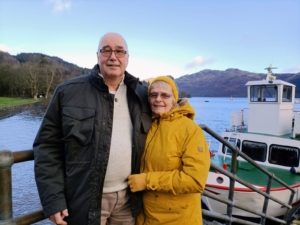
John and Doreen
Amazing care and respect
‘Jill from the palliative care urgent response service could not believe that Mum had been caring for Dad on her own. She referred us to the Hospice at Home service at Blythe House Hospicecare and Helen’s Trust, and a healthcare assistant (HCA) came out to be with us. She was lovely; she said, “I am here now, go to bed now.” She was quite firm and told us to sleep whilst she watched over Dad.
‘The care and respect she showed him, and the dignity she helped to maintain was just amazing. She was calm, respectful and safely took care of Dad’s needs, but she was there for us as much as Dad too.
‘Dad died peacefully at home on 3rd January 2023, with us by his side. I can’t quantify the care and support we received from the hospice and from DHU Healthcare which enabled Dad to stay at home; there aren’t enough words to truly explain the amount the teams did to help us. They just fitted with our thinking; they did what we wanted to do, and they understood what we wanted. We wouldn’t have known to ask for his care, because we wouldn’t have known it was there.
‘We have since given £700 in donations from Dad’s funeral to the hospice; and Mum finds solace in supporting the hospice’s Bakewell shop with donations. She loves the idea that she is able to support the work of the hospice to give care to someone else like Dad; that there will be someone to answer the phone when someone needs help.’
Helen also undertook the hospice’s Millers Dale bridge fundraising abseil in May 2023, alongside Richard, her cousin, raising over £650.
Helen explained: ‘I am overwhelmed at the support we have had. We are incredibly grateful. What we have achieved so far as a family, I am sure dad would be proud.’
Find out more about the Hospice at Home service.
Find out more about ways you can support Blythe House and Helen’s Trust.
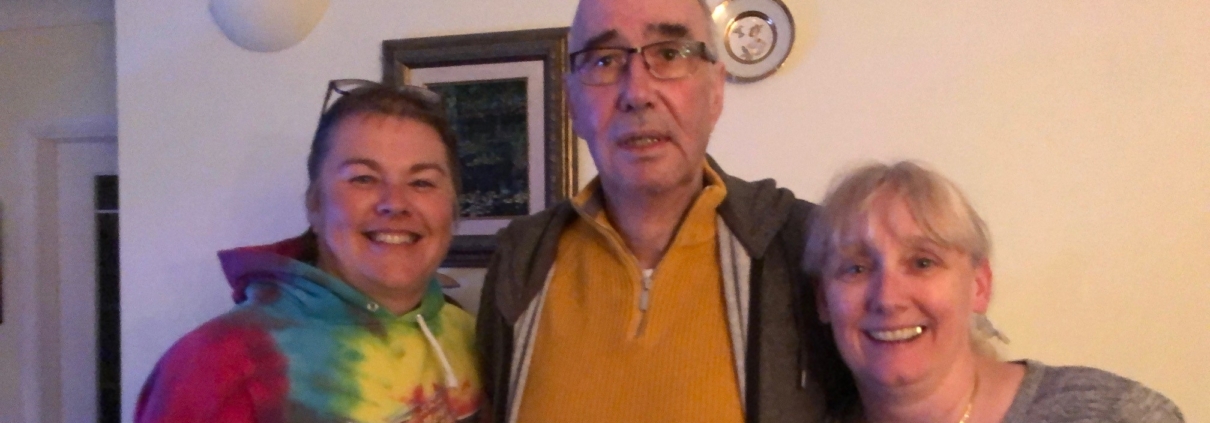
Header photo – John with Helen (left) and Sara (right)
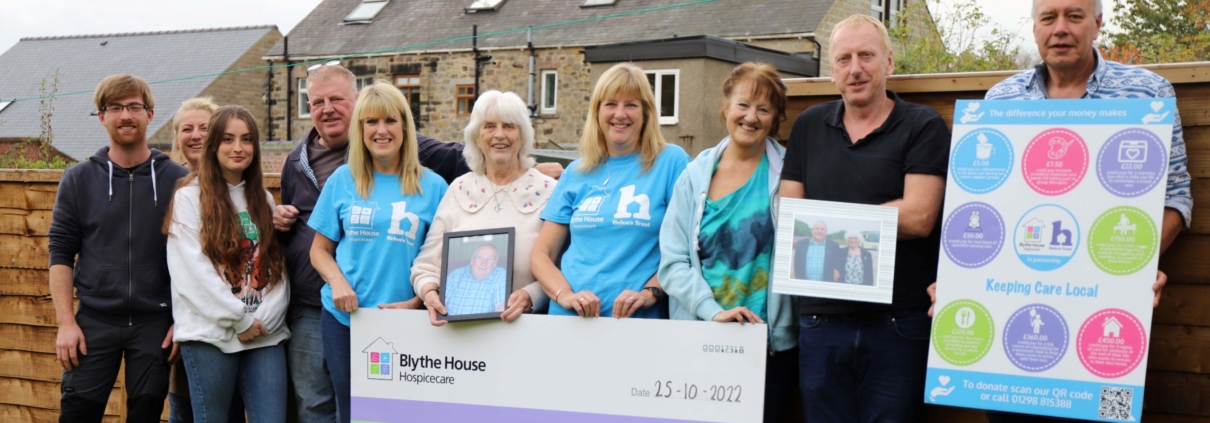
 Our Hospice at Home service started to provide care and support to Dennis in September 2021 in the comfort of his home in Hope, after a long spell of time spent in hospital due to a variety of complications following treatment to remove several gallstones that he had retained in his bile duct.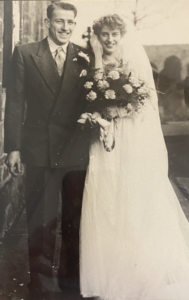
 Since the Covid-19 pandemic, the need for Hospice at Home care has never been more apparent. Our Hospice at Home service celebrated its seventh anniversary recently, and since its launch in 2016, the total hours of care provided per year has increased by almost 180%. GP surgeries and hospital services are busier than ever, and many more people wish to be cared for in the sanctuary of their home.
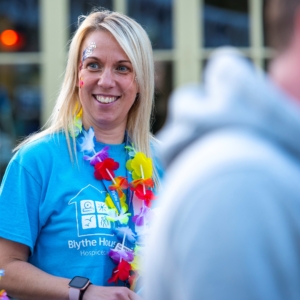 It is Rachael’s role to organise and coordinate our fundraising events to help raise the vital income needed to provide free hospice care and services to local people. It costs £2million every year to keep our services running and the hospice receives less than 20% of its income from the government; 80% must be raised through fundraising, and our local shops.
 ‘Our fundraising event portfolio has grown so much for 2023 and I am really looking forward to making them bigger and better as the years go on. We have an action-packed programme including golf days, a fire walk, abseil, the UK’s highest skydive, and the return of our super popular Chatsworth 10k and Jingle Bell Jog running events. There is something for everyone who would like to get involved in supporting their local charity!
 Julie, who originally hails from Aberdeen, has lived in Chapel-en-le-Frith for 15 years with her family. Here, she explains more about her background, and her current role here at Blythe House and Helen’s Trust:
 Sue set up the Stuart Fraser-Thomson Foundation in memory of her husband in 2011, after he died at home following his diagnosis with a terminal brain tumour. Stuart accessed care and support at Blythe House before his death.
 for Blythe House Hospicecare and Helen’s Trust such as: selling her handmade face masks during the pandemic, baking her amazing cakes and numerous Jingle Bell Jogs! I don’t have many talents hence why I have to do crazy things, such as skydiving and marathons to raise money for this amazing cause!
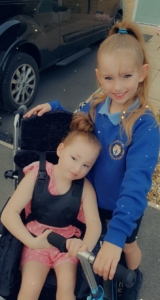 Amelia was just four-years-old when her best friend, Kaiden tragically died of leukaemia and pneumonia, aged just seven. Within five weeks of Kaiden’s very sudden and devastating death, Amelia’s little sister, Kacie was born with severe hypoxic-ischaemic encephalopathy*.
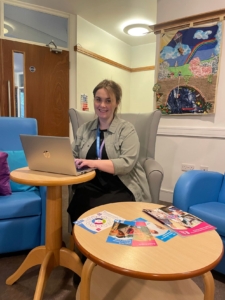 Lizzie plays a very important role in providing a link between the hospice and surgeries to coordinate care for local patients who may need hospice care and support as close to, or in, the comfort of their own home.
 Clare, who lives in New Mills, explained: ‘The lead up to Simon’s diagnosis was confusing. He had no visible symptoms at all; no cough or anything to alert us that there was something wrong. We moved to the High Peak in April 2021. Towards the end of May, Si called me from the hallway: “Clare, help me, I can’t walk. I am having to think about how to walk.” Si was a very active man; he loved walking and nature, especially bird watching, and he worked as an IT project manager at the University of Manchester, following many years as a self-employed IT consultant.
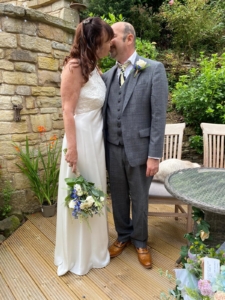 ‘Dr Parnacott was kind enough to help us get married at home in September 2021. After being together since 2017, we were due to have a big wedding day but Covid-19, and then Si’s prognosis, confirmed that this could not go ahead as planned. We were joined by my children and a registrar in our garden. It was a beautiful day, and we were due to have a small gathering of family and friends the next day to celebrate but unfortunately Si was just too weak and poorly.
